Multi-Head Latent Attention#
Note
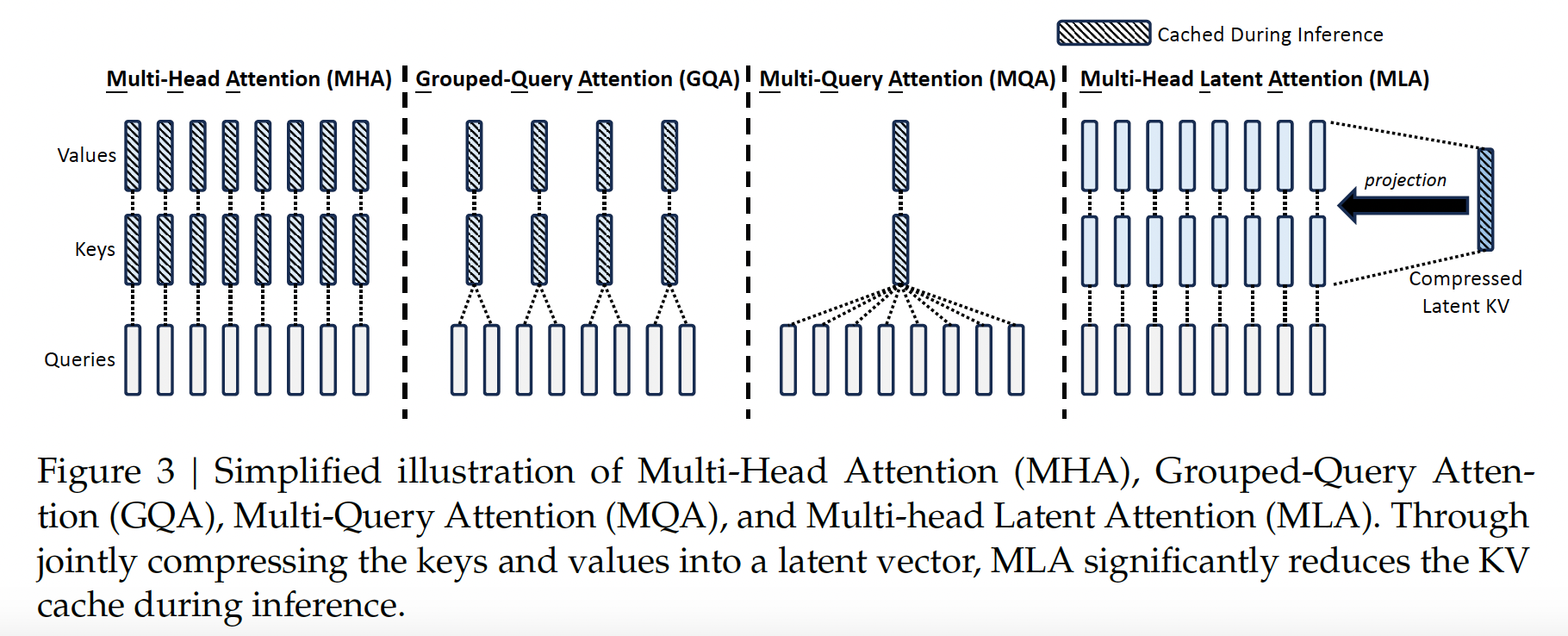
Conventional Transformer models usually adopts Multi-Head Attention (MHA)[VSP+23], but during generation, its heavy Key-Value (KV) cache will become the bottleneck that limit the inference efficiency. In order to reduce the KV cache, Multi-Query Attention (MQA). and Grouped-Query Attention (GQA) are proposed. They require a smaller magnitude of KV cache, but their performance does not match MHA.
For DeepSeek-V2, we design an innovative attention mechanism called Multi-head Latent Attention (MLA)[DALF+24]. Equipped with low-rank key-value joint compression, MLA achieves better performance than MHA, but requires a significantly smaller amount of KV cache.
Preliminaries: Standard Multi-Head Attention#
Let \(d\) be the embedding dimension, \(n_h\) be the number of attention heads, \(d_h\) be the dimension per head, and \(\mathbf{h}_{t}\in\mathbb{R}^{d}\) be the attention input of the \(t\)-th token. Standard MHA first produces \(\mathbf{q}_{t},\mathbf{k}_{t}, \mathbf{v}_{t}\in\mathbb{R}^{d_{h}n_h}\) through three matrices \(W^Q,W^K,W^V\in\mathbb{R}^{d_{h}n_{h}\times{d}}\), respectively:
Then, \(\mathbf{q}_{t}, \mathbf{k}_{t}, \mathbf{v}_{t}\) will be sliced into \(n_h\) heads for the multi-head attention computation:
where \(\mathbf{q}_{t,i},\mathbf{k}_{t,i},\mathbf{v}_{t,i}\in\mathbb{R}^{d_h}\) denote the query, key, and value of the \(i\)-th attention head; \(W^{O}\in\mathbb{R}^{d\times{d_{h}n_{h}}}\) denotes the output projection matrix.

Fig. 2 Multi-Head Attention, the red text indicates that it needs to be cached.#
Tip
During inference, all keys and values need to be cached to accelerate inference (the keys and values need to be computed only once), so MHA needs to cache \(2n_{h}d_{h}l\) (\(l\) denote layer num) elements for each token. In
model deployment, this heavy KV cache is a large bottleneck that limits the maximum batch
size and sequence length.
Low-Rank Key-Value Joint Compression#
The core of MLA is the low-rank joint compression for keys and values to reduce KV cache:
where \(\mathbf{c}_{t}^{KV}\in\mathbb{R}^{d_c}\) is the compressed latent vector for keys and values, \(d_c\ll d_{h}n_{h}\) denotes the KV compression dimension, \(W^{DKV}\in\mathbb{R}^{d_{c}\times d}\) and \(W^{UK},W^{UV}\in\mathbb{R}^{d_{h}n_{h}\times d_c}\). During inference, MLA only needs to cache \(\mathbf{c}_{t}^{KV}\), so its KV cache has only \(d_{c}l\) elements.

Fig. 3 Core of MLA: low-rank key-value joint compression.#
In addition, during inference (omit index \(i\) for brevity):
\(W^{UK}\) can be absorbed into \(W^{Q}\), that is:
Similarily, \(W^{UV}\) can be absorbed into \(W^{O}\). We even do not need to compute keys and values out for attention.
Tip
In order to reduce the activation memory during training (count params), we also perform low-rank compression for the queries, even if it cannot reduce the KV cache:
where \(\mathbf{c}_{t}^{Q}\in\mathbb{R}^{{d_{c}}'}\) is the compressed latent vector for queries, \({d_c}'\ll d_{h}n_{h}\) denotes the query compression dimension, \(W^{DQ}\in\mathbb{R}^{{d_c}'\times d}\) and \(W^{UQ}\in\mathbb{R}^{d_{h}n_{h}\times {d_c}'}\).

Fig. 4 Compression for queries.#
Decoupled Rotary Position Embedding#
RoPE[SLP+23] is position-sensitive for both keys and queries:
\(W^{UK}\) cannot be absorbed into \(W^{Q}\) any more during inference, since a RoPE matrix related to the currently generating token will lie between \(W^{Q}\) and \(W^{UK}\) and matrix multiplication does not obey a commutative law.
As a solution, we propose the decoupled RoPE strategy that uses additional multi-head
queries \(\mathbf{q}_{t,i}^{R}\in\mathbb{R}^{d_h^{R}}\) and a shared key \(\mathbf{k}_{t}^{R}\in\mathbb{R}^{d_h^{R}}\) to carry RoPE, where \(d_{h}^{R}\) denotes the per-head
dimension of the decoupled queries and key. Equipped with the decoupled RoPE strategy, MLA
performs the following computation:
where \(W^{QR}\in\mathbb{R}^{d_{h}^{R}n_{h}\times {d_{c}}'}\) and \(W^{KR}\in\mathbb{R}^{d_{h}^{R}n_{h}\times d}\) are matrices to produce the decouples queries and key. During inference, the decoupled key should also be cached. Therefore, DeepSeek-V2 requires a total KV cache containing \((d_c+d_{h}^{R})l\) elements.

Fig. 5 Multi-head Latent Attention.#
Tip
MLA uses decoupled keys and queries to carry RoPE, where keys are shared across tokens to save cache.